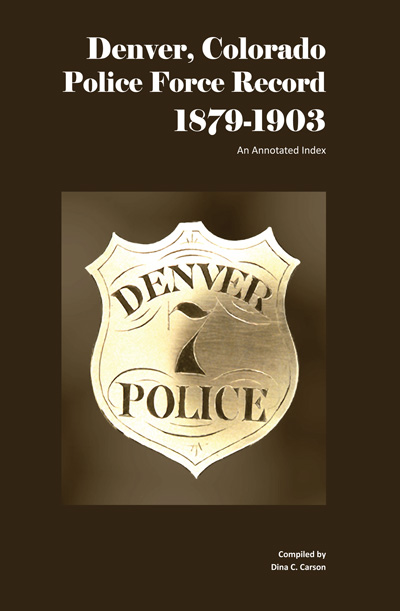
This index has been compiled from a register of Denver Police Department hires beginning in 1879 and ending in 1903. Officers were hired as patrolmen and officers, detectives, turnkeys (keepers of the keys at the jail), clerks, doctors and surgeons, jailers, bailiffs, herders and hostlers (who took care of the department’s horses), drivers (who drove the ambulance and paddy wagon), operators (who took emergency calls once the city had telephones), and license inspectors. The Denver Police Department first hired a police matron in the 1880s and used special police, sometimes unpaid citizens, other times paid temps to keep the streets safe during city-wide celebrations.
The register includes the following information: the officer’s name, the rank hired, the star or badge number assigned, where the officer was born, the officer’s age at hire, the officer’s former occupation, whether married or single, the number of people in the officer’s household, the officer’s address at hire, dates of appointment and discharge (cause, if given), equipment assigned (fire key, police key, small buttons, large buttons, club, belt, nippers, regulation book, locker), and remarks.
The original Denver Police Department Force Record, 1879-1903 is held by the Colorado State Archives and is accessible for research. You can order a copy of a page from the register by calling the Colorado State Archives or placing an order through their website.
ISBN 978-1-879579-81-1, $11.95
Available from Amazon.com
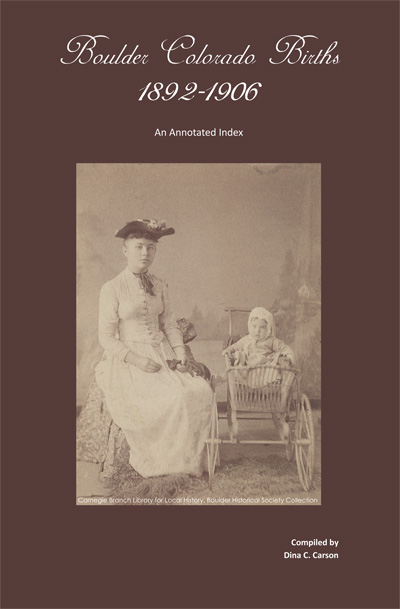
This index has been compiled from the original birth records filled out by physicians after a birth and turned in to the County Clerk. They were then recorded in the Birth Records Book, Volume 2, for Boulder County. Often the forms were not turned in until months after the birth. Based upon the form numbers recorded, there are many missing certificates for this time period.
There are many different types of forms in the records so the information available for each individual can be quite different. The more complete forms include the following information: the record number, the child’s name, the child’s color, the child’s sex, whether the child was born alive or not, the place where the child was born, the hour and date, the father’s name and occupation, the mother’s maiden name, where the parents lived at the time of the birth (often different than where the birth took place), the names of the other children (sometimes just the number of siblings), notes about any additional circumstances (including information about the death of the child or the death of one of the parents), the physician who attended the birth, where the physician resided, the date the form was filled out (or returned to the clerk) and the page and volume number where the birth was recorded.
ISBN 978-1-879579-79-8 $11.95
Available on Amazon.com
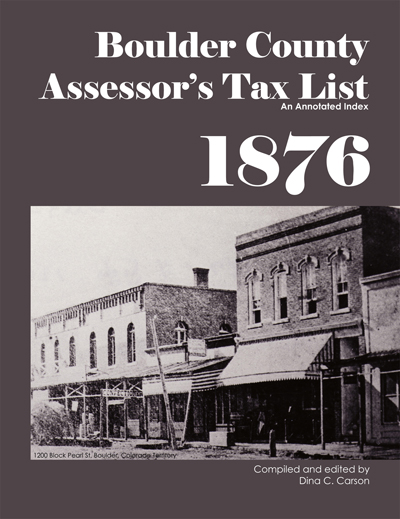
In 1876, the tax records record either the residence (address) of the property in town lots and blocks or the legal description (section, township and range) and number of acres the property holds. It gives a valuation of the property and of the improvements. It makes an assessment of the capital investment in merchandise and manufacturing, how much is held in money and credits, shares and stocks. It notes household property, jewelry, gold and silver, the number and value of: clocks and watches, musical instruments, carriages and vehicles, horses, mules, cattle, sheep, swine and other animals. It shows improvements on homesteads and public lands, and the amount of other property. It sums up by giving a total valuation of city and county property. It lists how many polls (men able to vote), amount of increased or decreased valuation, and remarks. Looking at the tax assessment role will give you a pretty good indication of how these people lived and worked.
print ISBN 978-1-879579-56-9 $11.95
ebook ISBN 978-1-879579-60-6 $5.95
Available on Amazon.com
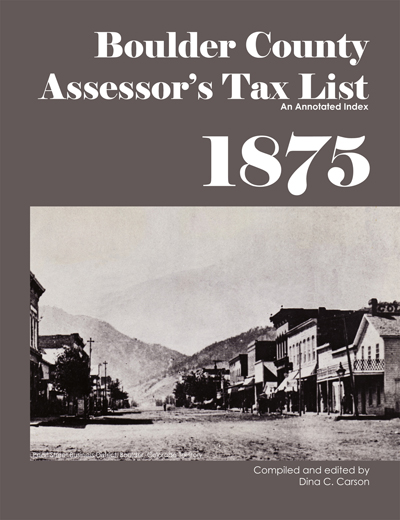
In 1875, the tax records record either the residence (address) of the property in town lots and blocks or the legal description (section, township and range) and number of acres the property holds. It gives a valuation of the property and of the improvements. It makes an assessment of the capital investment in merchandise and manufacturing, how much is held in money and credits, shares and stocks. It notes household property, jewelry, gold and silver, the number and value of: clocks and watches, musical instruments, carriages and vehicles, horses, mules, cattle, sheep and other animals. It sums up by giving a valuation of all other property, and a total valuation. It lists how many polls (men able to vote), and remarks. Looking at the tax assessment role will give you a pretty good indication of how these people lived and worked.
print ISBN 978-1-879579-55-2 $11.95
ebook ISBN 978-1-879579-56-9 $5.95
Available on Amazon.com
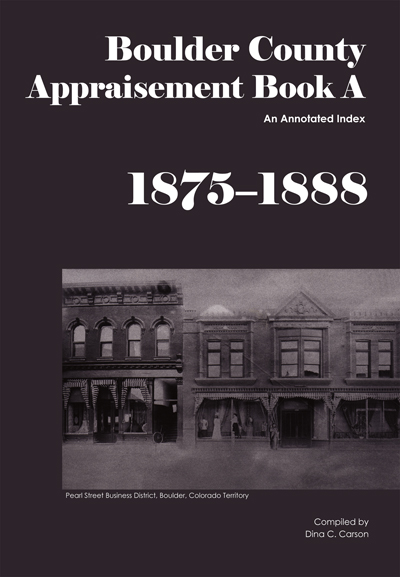
In the Boulder County Probate Court’s Appraisement Record, you will find the name of the deceased, the Judge and Sheriff charged with administering the appraisement of personal property, the administrator or executor of the estate, the names of the appraisers of the estate, usually three.
Occasionally, you will find the name of a Justice of the Peace before whom the Appraisers took their oath, if different from the Judge charged with administering the appraisement.
The Appraisers estimate also includes the value of property allowed to the widow including: Beds, bedsteads and bedding, Wearing apparel, household furniture, family pictures, school books and library, stoves, cooking utensils, provisions and fuel necessary for six months, Working animals, one cow and calf, ten sheep, one horse, saddle and bridle, food necessary for animals for six months, one farm wagon, one plow, and one harrow.
The second page(s) of the Appraisement includes all articles appraised and their value, including livestock, land, household goods, farm implements, and ownership in businesses or mines. Occasionally, you will find other people named if there are accounts owed or notes outstanding.
The Boulder County Probate Court Appraisement Record A is held by the Colorado State Archives and is accessible for research. You can order a copy of pages from this Appraisement Book by calling the Colorado State Archives or placing an order through their website.
eBook ISBN 978-1-879579-71-2, $5.99
print ISBN 978-1-879579-72-9, $11.95
Available on Amazon.com
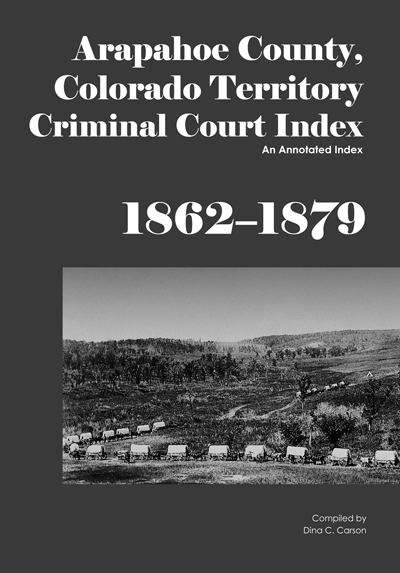
The Arapahoe County Criminal Court Index 1862-1879 contains an alphabetical list of criminal cases filed by the name of the first defendant listed on the case.
It gives the date of filing, the case number, the charge, the book and page number of subsequent hearings, and a brief description of the findings of those hearings. Often, the dispensation of the case will be given in the notes.
The very early cases, listed as occuring “bef 1862,” have no actual dates on the case but occur in the order of cases before others prosecuted in late 1862. These early cases being prosecuted as The People of the United States of America vs the defendant, and were probably in the jurisdiction of the US Marshals. Most of these cases are listed as Treason, etc., most likely cases of Southern sympathizers as the Civil War was underway.
It appears that the courts had their hands full with notorious saloon-owning brothers Edward and John Chase, not to mention forgers and miners passing off counterfeit gold dust.
The Arapahoe County Criminal Court Index is held by the Colorado State Archives and is accessible for research. You can order a copy of pages from the Arapahoe County Criminal Court Index, 1862-1879 by calling the Colorado State Archives or placing an order through their website.
eBook ISBN 978-1-879579-69-9, $5.99
print ISBN 978-1-879579-70-5, $11.95
Available on Amazon.com
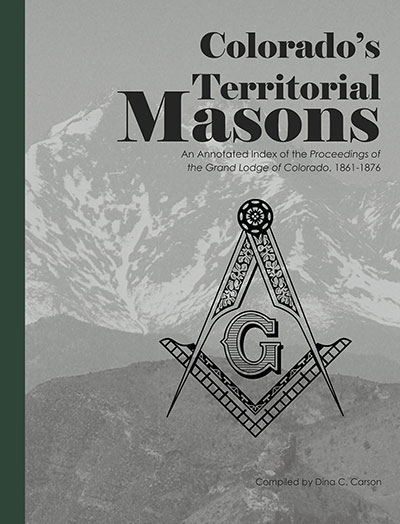
Colordo’s Territorial Masons: An Annotated Index of the Proceedings of the Grand Lodge of Colorado, 1861-1876
March 19, 2013
The Masons have a history in Colorado longer than the state or territory itself. The first Masonic lodges formed in the area were done so under dispensation from the Grand Lodges of Kansas and Nebraska until Colorado became a Territory in 1861 and formed its own Grand Lodge. Between the time Colorado became a territory in 1861 and a state in 1876, thirty-one Masonic lodges were formed with the help of more than 4,000 local men whose names are included in this index. The Proceedings of the Grand Lodge of Colorado often included news from Masons in other states, as well as the names of officers of the other Grand Lodges around the county. Their names are also included.
New Book, now available on Amazon.com
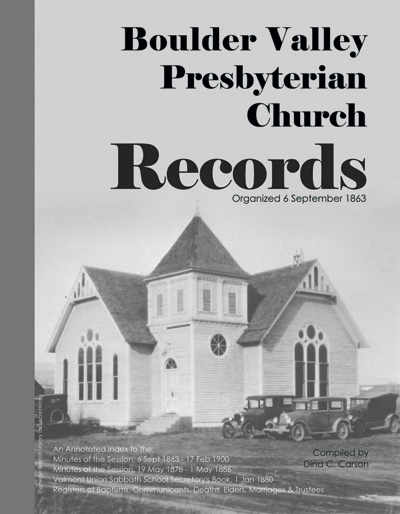
Boulder Valley Presbyterian Church Records, 1863-1900
September 8, 2012
The Valmont Community Presbyterian Church, originally called the Boulder Valley Presbyterian Church, was one of the first churches organized in the Boulder Valley. The church was organized on 6 September 1863 in the community of Valmont near the confluence of the North Boulder and South Boulder Creeks. The early records of the church are privately held but were graciously opened to the Boulder Pioneers Project for extraction and indexing. This book is an annotated index of: The Minutes of the Session 6 Sept 1863-17 Feb 1900; Minutes of the Session, 19 May 1878 – 1 May 1886; Valmont Union Union Sabbath School Secretary’s Book dated 1 Jan 1880, and the registers of Baptisms, Communicants, Deaths, Elders, Marriages and Trustees.
Available at Amazon.com
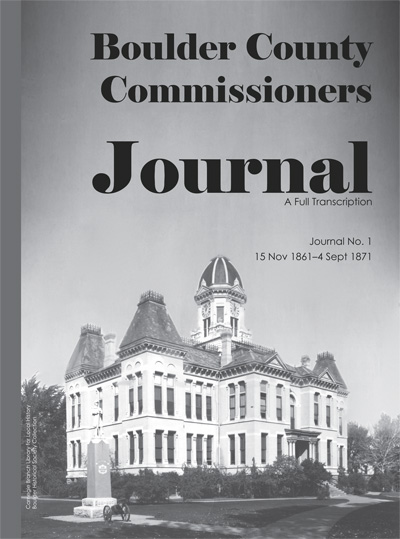
New book – Boulder County Commissioner’s Journal, 1861-1871: An Annotated Transcription
August 21, 2012
If you had an ancestor in the Boulder area before 1871, chances are good that he (and sometimes she) is mentioned in the County Commissioner’s journal. Boulder County was one of the original 17 counties established when Colorado became a territory on 14 February 1861. The Boulder County Commissioner’s Journal, 1861-1871, chronicles the building of the county and the people who helped build it. During that time, citizens in Boulder built new roads, a jail and a courthouse, paid for the care and keep of paupers, and maintained law and order. All the while, the County Commissioners hired and paid for work on behalf of the county, chose grand and petit jurors, appointed road viewers and overseers, and took applications for business licenses. Includes an index to the original journal as well as an index to this modern version.
Available on Amazon.com
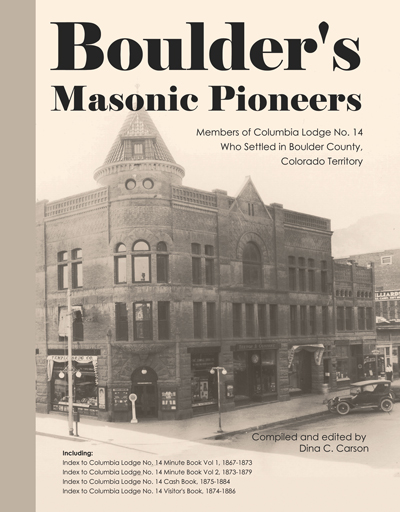
Boulder’s Masonic Pioneers, 1867-1886: Members of Columbia Lodge No. 14, Boulder County, Colorado Territory
August 17, 2012
ISBN 978-1-879579-57-6
This title includes:
Index to Minute Book, Vol 1, Columbia Lodge No. 14, 1867-1873
Index to the Minute Book, Vol 2, Columbia Lodge, 1873-1879
Index to the Cash Book of the Columbia Lodge No. 14, Vol 1 1875-1884
Index to the Visitors Book of the Columbia Lodge, 1874-1886
Available from Amazon.com


 Boulder Pioneers Project